An exceptional monument

The monument

The Basilica of the Sacred Heart is a wonderful Art Deco Monument.

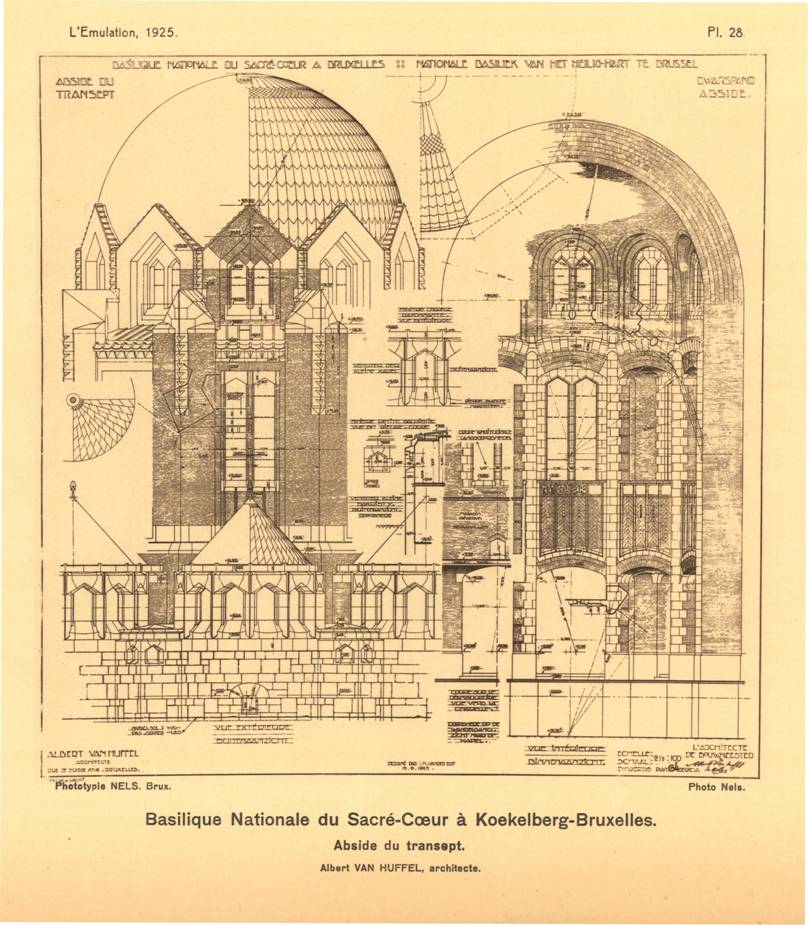
The Architect, Albert Van huffel, left no unused space in the Basilica: the huge church has space beneath it for meeting rooms, a crypt, a theatre, a weekday chapel, accommodation for the caretaker, in other words… a city within the city!

In this chapter, you will find more information about Art Deco, the Stained Glass, Sculptures and the Liturgical Furniture and Crockery of the Basilica.

het monument - basilica koekelberg

Art deco

The architect Albert Van huffel was looking for the deeper meaning of ornaments in architecture. His life’s work, the creation of the national basilica of the Sacred Heart, is therefore the most honest and interesting Art Deco building in Western Europe.

The Art Deco features consist of clear and straightforward lines, composed of compact and simple volumes in brick, stonework and natural stone. The building’s structure is completely made of reinforced concrete, using glazed terracotta as permanent framework.

The glazed terracotta as a decorative element inside the building creates a specific warm atmosphere, in spite of the chilliness of the material itself.

Stained Glass

The first stained glass in the basilica was installed in 1937. The collection of stained glass grew gradually with the construction of the basilica, as the donations of the religious, the Christian organisations and societies followed. The designs were put on carton by ten of the best stained glass artists who worked in our country halfway the 20th century. The quality of the stained glass is therefore very diverse.

Carte Lam Gods

The theme of the stained-glass in the apse is the Eucharist and the adoration. In the big nave the life of Jesus is told, as in the galleries the eight salvations, are the subject of the stained glass. Afterwards, stained glass was also put in the side chapels.

The most important artists that co-operated are Anto-Carte, Louis-Charles Crespin, Jan Huet, Michel Martens, Jean Slagmuylder, Maria Verovert and Pierre Majerus (pictures).

Above the main entrance sits Anto Carte’s imposing work, “The Adoration of the Lamb of God and the Last Judgment.”

Sculptures

The new religious architecture designed by Albert Van huffel, functionally disposed of the unnecessary, foresaw from in the beginning an impressive ciborium for the main choir, and a marble altar for the parochial part with a sculpture of the Sacred Heart.

Two famous artists, George Minne and Harry Elstrøm, made sculptures for the basilica. They represent two different traditions in the Sculpture art, which were confronted with each other due to the slow construction of the basilica.

George Minne

George Minne was born in Ghent in 1866 as a son of an architect. From 1882 till 1884 he studied in the Academy of Fine Arts in Ghent and he focused on the painting of biblical subjects. Thanks to his friendship with Maurice Maeterlinck, he was introduced in the symbolic school.

In 1898 he moved to Sint-Martens-Latem, where he will live until his death in 1941, with the exception of a stay in Wales during World War I.

He was a member of the innovative Belgian group of artists “Les XX” (Les Vingt).

For the Basilica of Koekelberg, Minne made the sculpture of the Sacred Heart for the altar in the apse. He also made the bronze calvarie at the outside of the basilica.

Harry Elstrøm

Harry Elstrøm (1906-1993) was born in Berlin in 1906 as the son of a German industrial and an English author. He studied art and history of art in Dresden, Rome and Brussels. In 1934 he settled as an independent artist in Brussels. Elstrøm is known above all for his innovative work in religious art. In 1940, he became teacher in sculpture in the Saint-Lucas Institute of Brussels, and in 1952 he started teaching at the faculty of Applied Science at the Catholic University of Leuven.

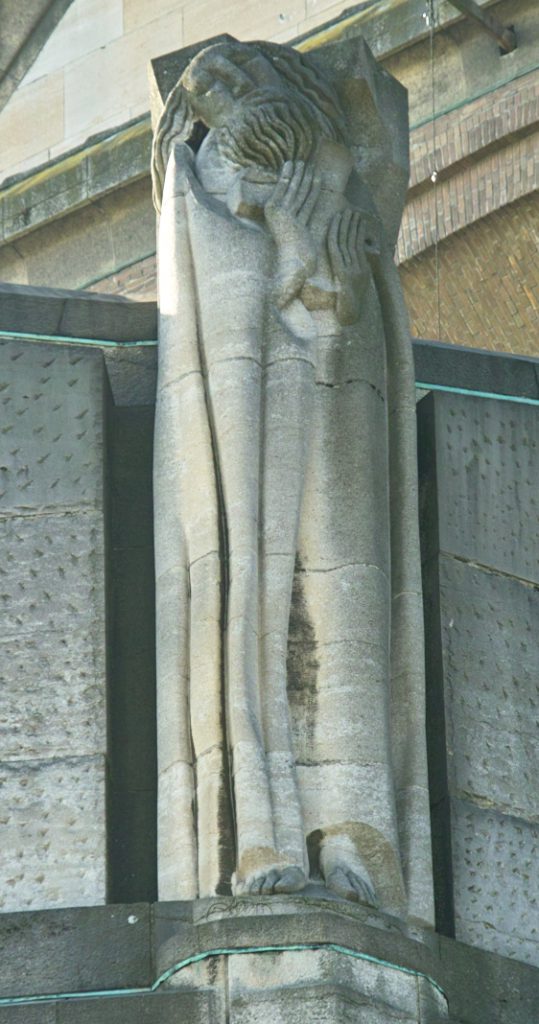
The impressive sculptures Harry Elstrøm made for the basilica are expressionistic. The sculptures fit very well with the concept of the basilica and accentuate its grandeur. The most important work of Elstrøm for the basilica is the majestic calvarie with the four angels above the ciborium of the main choir.

The sculptures of the four evangelists at the outside of the basilica above the narthex are also made by Elstrøm.

Liturgical Furniture and Crockery

In the developmental stage, the liturgical furniture was very decorative, but in the 1930s, the designs were more sober and majestic. The baptismal font of the basilica is made following the design of Albert Van huffel, many years after his death. It’s a last tribute to the genius of Van huffel, who sacrificed part of his life and his career to the National Basilica of Koekelberg.

Van huffel did not leave instructions for the design of a coherent collection of liturgical crockery. The collection of the basilica was completed throughout the years with objects that were given for special occasions in the basilica or objects which arrived here by coincidence. It’s a unique collection because the items date almost exclusively from the 20th century. The most beautiful and original pieces were made in the 1930s in the workshops in Brussels from Camille Colruyt, Devroye Frères and Henri-Joseph Holemans.

A part of the liturgical crockery can be seen in the Museum of the Black Sisters.